The Brown Thesis: Reconstructing a Community Through Its Records
One integrated Brown MA research project brings together research on Jewish refugees in wartime Shanghai and the older Henan Jewish community, an exhibition, and two screenplays. The exhibition and screenplays are different responses to the historical record and its limits.
Exhibition
The Paper Haven: Jewish Refugees in Shanghai, 1938–1950
Curator · Forthcoming January 2027
First showing scheduled for 27 January 2027, International Holocaust Remembrance Day, at the Nanovic Institute for European Studies, University of Notre Dame.
Joyce is in talks with the Leo Baeck Institute, Brown RISD Hillel, the Austrian Cultural Forum New York, and the Sino-Judaic Institute about presenting The Paper Haven as a traveling exhibition.
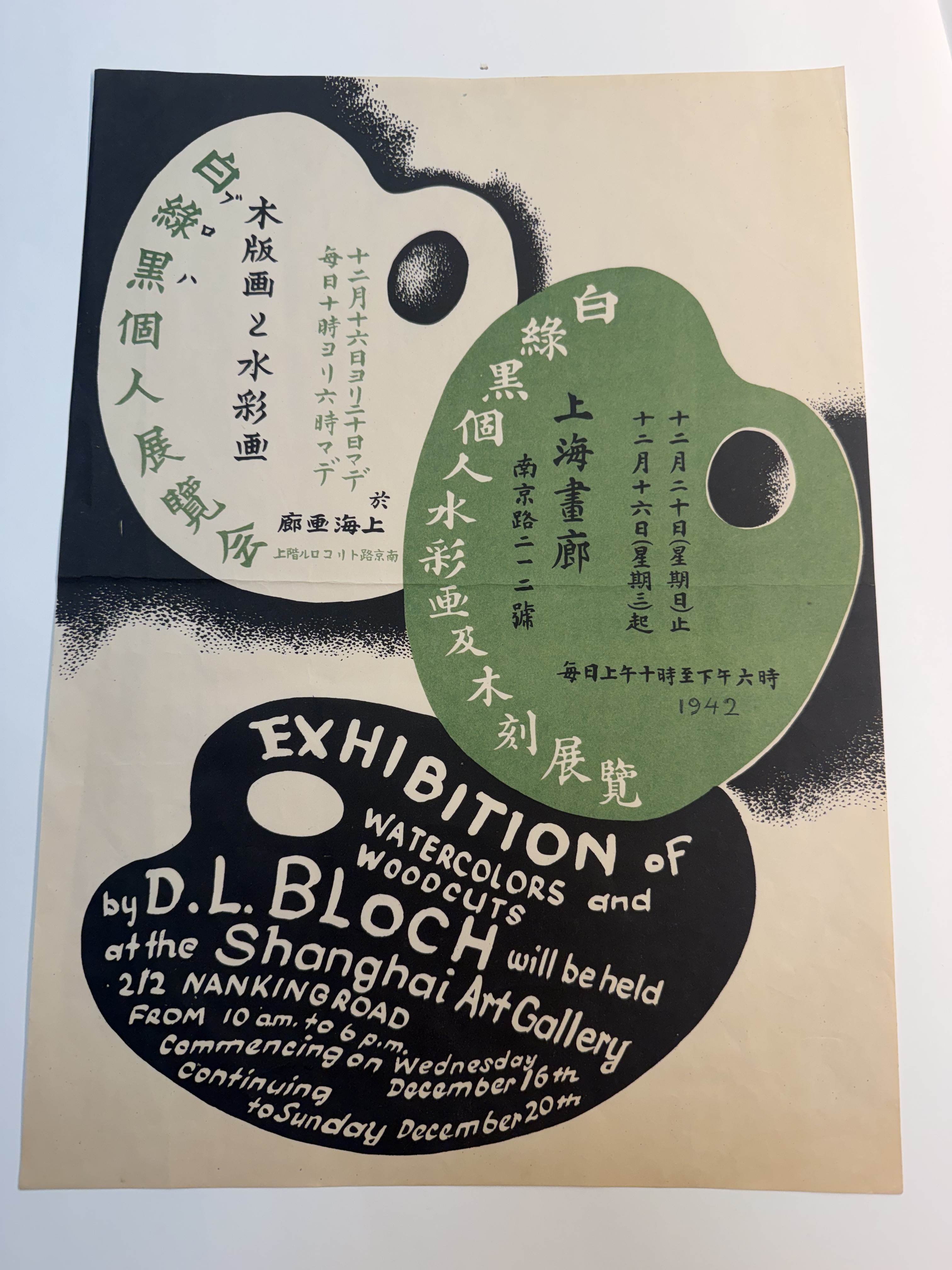
Image: D. L. Bloch exhibition flyer, Shanghai, 16–20 December 1942. Courtesy of the Leo Baeck Institute, David Ludwig Bloch Collection, AR 7199.
Reproduction permissions granted by the Leo Baeck Institute, the University of Bristol’s Historical Photographs of China, and the Muskie Archives at Bates College.
THE PAPER HAVEN · EXHIBITION IN DEVELOPMENT
A journey through the exhibition
The working section plan follows people through documents. Its central proposition: “Displacement does not put people outside hierarchy. It relocates them within one.”
The sequence below follows the working object plan begun 2 October and updated through 21 October 2026. Section descriptions are curatorial summaries; the documents below can be inspected directly.
I · Vienna+
ANCHORED BY THE GOLDSTAUBS
Passports, visas, and the decisions that made departure possible. The section follows the Goldstaub family and places the documents of escape beside the conditions from which they fled.
II · The Passage+
ANCHORED BY THE JACOBSBERGS
Passenger receipts, shipping records, and permissions trace the passage from Europe to Shanghai. The documents make the route legible while showing that permission on paper did not guarantee arrival.
III · Little Vienna+
ANCHORED BY HARRY FIEDLER, WITH THE GOLDSTAUBS
Photographs, marriage and birth records, advertisements, and exhibition ephemera bring refugee life into the same frame as the Chinese city around it. These materials hold everyday encounter and social hierarchy together.
IV · The Paper Dies+
ANCHORED BY FRIEDRICH MELCHIOR
Passes and their renewals turn permission to move into a recurring administrative act. The section examines the designated area and the authority of the pass office through the documents and testimony that survive.
V · Stateless / 再見+
ANCHORED BY DAVID LUDWIG BLOCH
Departure papers, artworks, newspapers, and the record of the 1948 YIVO exhibition follow what was carried out of Shanghai. The final movement asks how a dispersed community becomes a historical record.
FROM THE RESEARCH FILES
A sample from the exhibition
Two objects from the David Ludwig Bloch Collection connect refugee artistic practice to Shanghai’s multilingual cultural life. Open either reproduction to examine the document at full size.
A photographer’s method, beside an advertisement
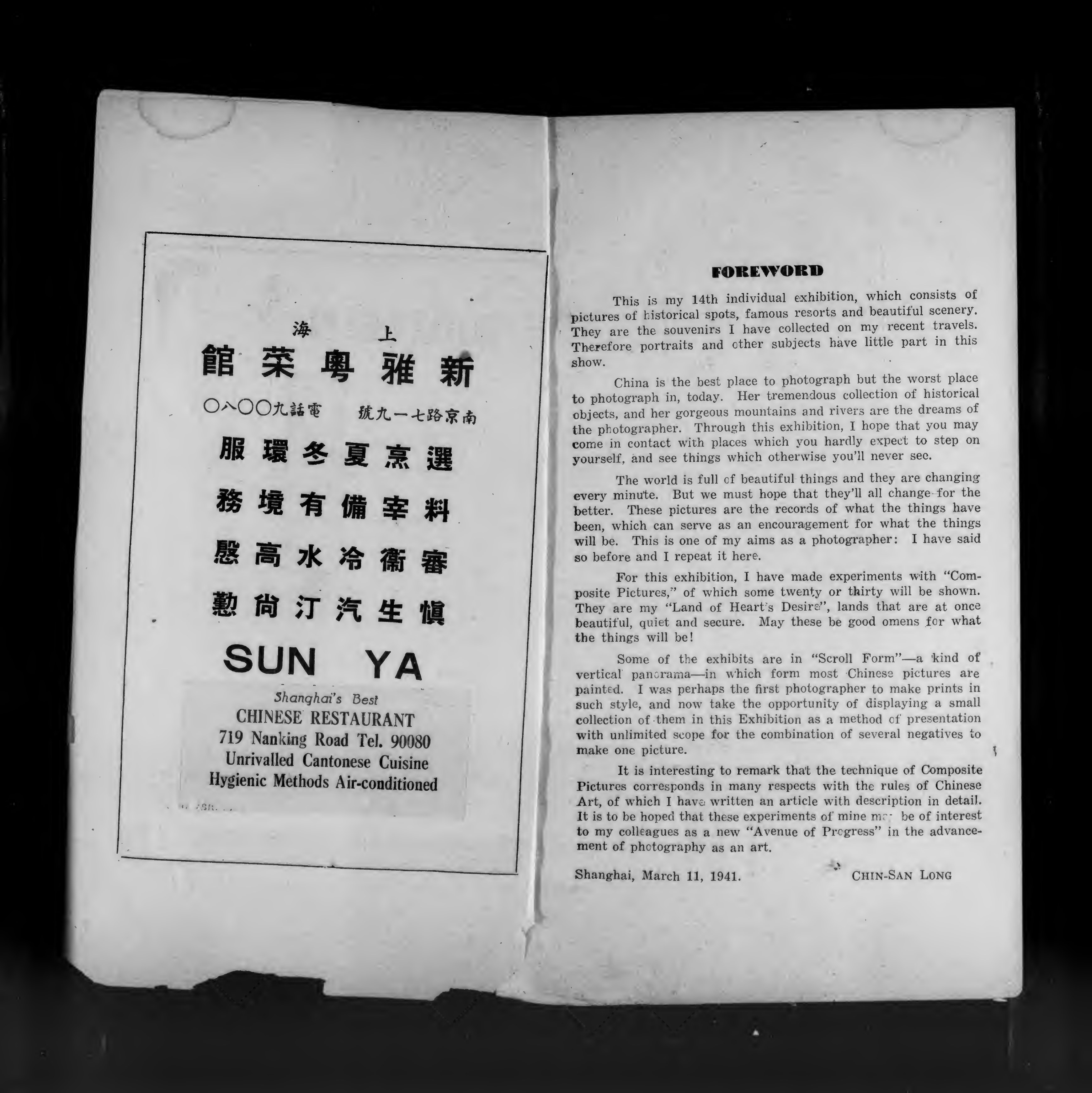
14th Exhibition of Pictorial Photography, Chin-San Long (Long Chin-San / 郎靜山), Shanghai, 11 March 1941. Foreword facing a Sun Ya restaurant advertisement.
Evidence & interpretation+
On the page: Long describes experiments with composite pictures and the combination of several negatives. Opposite, Sun Ya advertises its Nanking Road restaurant in Chinese and English.
Curatorial reading: the spread places photographic construction and commercial address together. Preserved in Bloch’s collection, it opens a route into the artistic and commercial worlds surrounding refugee practice.
Research limit: the working notes record a disagreement between the finding aid and the archivist’s card over the folder number. The collection reference is retained here without choosing an unconfirmed folder.
Leo Baeck Institute, David Ludwig Bloch Collection, AR 7199. Reading-room reproduction from the research files; object 90.
D. L. Bloch, watercolors and woodcuts exhibition flyer, Shanghai Art Gallery, 16–20 December 1942.
Evidence & interpretation+
On the page: overlapping palette forms carry the exhibition announcement in several languages. The English text gives the dates and the Shanghai Art Gallery address; “1942” is written on the sheet.
Curatorial reading: this is evidence of an artist addressing a multilingual public. The flyer lets a visitor encounter the means by which an exhibition circulated, alongside the work it announced.
Research limit: an announcement establishes an advertised event, not who attended or how it was received.
Leo Baeck Institute, David Ludwig Bloch Collection, AR 7199. Reading-room reproduction from the research files; object 97.
The research process keeps the object, its transcription or translation, and the curator’s interpretation distinguishable. Collection references and reproduction permissions accompany the material; uncertain readings remain visible rather than becoming settled facts in a caption.
The exhibition brings selected records into a public sequence. Little Vienna and The Rabbi of Shanghai emerge from the same research, with a different formal problem: what a screenplay can reconstruct where the documentary record ends.
The exhibition pack proposes reproductions on rigid panels, with an approximately forty-linear-foot format and a six-panel version for smaller spaces. The traveling format makes the research portable without requiring original archival objects to travel.
Two screenplays
From the Cullman research proposal:
Two feature screenplays, written out of one body of research, following one boy across fourteen years.
Little Vienna
Writer · In development
Little Vienna, 1933–1945, belongs to Simson Blumenthal, a German-Jewish doctor who reaches Shanghai in 1933 and spends the next years failing to get his wife and son out of the Reich, through a door that stands open the whole time. He is not stopped by a closed border. He is stopped by money, by his own letters home, which describe the city so well it sounds like a place a person can simply arrive — and by his wife, who has reasons of her own. Leah was born Catholic and converted when she married him. Nazi law counts her as Aryan; she plays second chair in the Kulturbund, the only stage left to Jewish musicians in Berlin, to two hundred people forbidden every other hall. She lets a sailing go because she is needed where she is. When she finally runs, she runs on an expired Austrian passport from a country that has been annexed out of existence, and it works. Then, on 14 August 1937 — Bloody Saturday — there is no morphine in the city, and Simson spends the passage fund on morphine for a Chinese neighbour's courtyard. He does not experience this as a choice. It is the one his family pays for. The film asks whether that debt can be paid. It is drafted through Act One; the writing sample is drawn from it.
Developed with rewrite feedback from producer Louis Spiegler.
The Rabbi of Shanghai
Writer · In development
The Rabbi of Shanghai, 1941–1947, belongs to his son Isaac, who arrives last and changed, and it does not exist yet. It opens when a thousand students of the Mir Yeshiva reach Hongkou from Lithuania by way of Kobe — the most observant Jews in the city walking into a community of assimilated Viennese who do not recognize them as the same thing they are. Fifteen months later the proclamation treats all of them identically. Isaac is the boy the city saves, and the one who stays to keep its memory — the film ends two years after the war, when everyone else goes. It asks who counts as a Jew, and who gets to say.
Proposed research: listening for the scene
The answers change scenes, not footnotes. An account of the pass window given in three false starts tells me the scene is about the approach, not the verdict. A woman who switches to German only when she reaches her mother tells me which language a room is in. This is the difference between writing a period and writing people who lived in one.